

Bathrooms are inherently high-humidity environments. Every shower or bath releases significant amounts of water vapor into the air. Without adequate ventilation, this moisture has nowhere to go. It condenses on cooler surfaces like walls, ceilings, mirrors, and fixtures, leading to a host of problems.
Over time, persistent moisture creates an ideal breeding ground for mold and mildew, which manifest as unsightly black, green, or pink stains.
Beyond aesthetics, this can lead to peeling paint, damaged grout, warped wooden elements, and a pervasive musty odor. These issues not only degrade the appearance and structural integrity of your bathroom but can also contribute to poor indoor air quality.
Dealing with Moisture, Odors, and Other Allergens
Effectively managing bathroom moisture is crucial for maintaining a healthy and comfortable home. The first line of defense is proper ventilation.
Always use your exhaust fan during and after showers or baths, ideally for at least 15-20 minutes. Opening a window, if available, can also help. Regular cleaning with mold-inhibiting products can keep surfaces pristine.
Promptly addressing any leaks from plumbing or fixtures is also vital. However, for persistent issues, especially in larger bathrooms or homes in humid climates, a more robust solution might be necessary.
Dehumidifiers: A Powerful Solution
This is where a dehumidifier can become an invaluable tool.
A good dehumidifier actively removes excess moisture from the air, significantly lowering the relative humidity. This not only prevents the growth of mold, mildew, and dust mites (common allergens) but also eliminates musty odors, making your bathroom and surrounding areas feel fresher and more comfortable. For comprehensive humidity control, especially in larger spaces or those prone to high moisture, a powerful and efficient dehumidifier is an excellent investment.
Midea Cube 50 Pint Dehumidifier with Pump: Your Ally Against Humidity
Among the many options available, the Midea Cube 50 Pint Dehumidifier with Pump stands out as a highly capable device for tackling significant humidity challenges. Its innovative design and powerful performance make it a popular choice for homeowners.
Coverage Area: 4,500 sq. ft. Explained
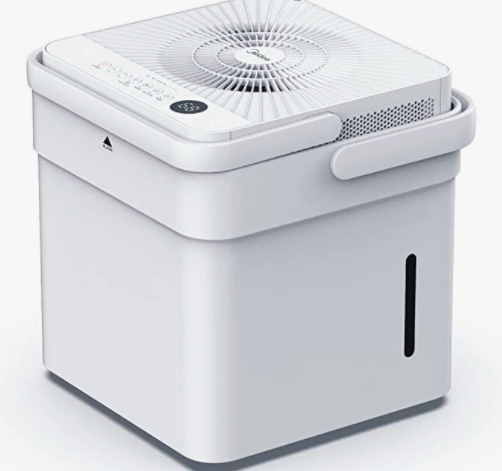
The Midea Cube 50 Pint Dehumidifier is rated to cover an area of up to 4,500 square feet. To put this into perspective, 4,500 sq. ft. is equivalent to a very large basement, an entire floor of a substantial home, or multiple interconnected rooms.
It’s designed for significant spaces, not just a single small bathroom. When considering cubic measure, which accounts for volume, if we assume an average ceiling height of 8 feet, 4,500 sq. ft. translates to an impressive 36,000 cubic feet (4,500 sq. ft. * 8 ft).
This demonstrates its capacity to effectively manage humidity in vast open-plan areas or several rooms simultaneously, making it far more powerful than what a typical bathroom alone would require.
How the Midea Cube Works and Where Moisture Goes
The Midea Cube operates by drawing in humid air from the room using a fan. This air then passes over a set of cold coils (evaporator coils). As the warm, moist air comes into contact with these cold surfaces, the water vapor condenses into liquid water droplets, much like dew forming on a cold glass. This collected water drips into a built-in water reservoir (bucket). The now-drier air is then reheated slightly and expelled back into the room.
The Midea Cube’s key feature is its integrated pump. This pump allows the collected water to be continuously drained upwards or horizontally through a hose to a sink, drain, or even out a window, eliminating the need for frequent manual emptying of the bucket. If the pump isn’t used, the water collects in the internal bucket, and the unit will automatically shut off when the bucket is full.
Optimal Placement for Your Midea Cube
For maximum efficiency, place the Midea Cube in a central location within the largest or most humid area you wish to dehumidify.
Ensure there’s at least 6-12 inches of clearance around all sides of the unit to allow for unrestricted airflow. Avoid placing it directly against a wall, in a corner, or in front of furniture that could block its air intake or exhaust.
While it’s designed for large areas, if your primary concern is a specific bathroom, placing it just outside the bathroom door or in an adjacent hallway can help draw moisture out of that space. Consider noise levels; while generally quiet for its capacity, you might prefer it not directly in a quiet living space.
Pros and Cons: Good and Not So Good
Good (Pros):
- High Capacity: 50-pint (DOE) rating effectively tackles high humidity in large spaces up to 4,500 sq. ft.
- Integrated Pump: Offers continuous drainage options, eliminating the need to manually empty the water bucket.
- Compact “Cube” Design: Its unique stackable design allows for a smaller footprint when the bucket is removed, making it easier to store or fit into tighter spaces.
- Quiet Operation: Generally considered quieter than many comparable dehumidifiers, enhancing comfort.
- Smart Features: Often includes Wi-Fi connectivity, allowing control via a smartphone app.
- Energy Efficient: Designed to operate efficiently, helping to keep energy bills manageable.
Not So Good (Cons):
- Initial Cost: Can be a higher upfront investment compared to smaller, simpler models.
- Requires Drainage Setup: While the pump is convenient, setting up the continuous drainage hose requires a bit of initial effort.
- Size: While compact for its capacity, it’s still a substantial appliance and requires dedicated space.
- Maintenance: Requires regular filter cleaning and occasional bucket cleaning to maintain efficiency.
Convenience and User Experience
The Midea Cube prioritizes user convenience. Its digital controls are intuitive, allowing you to easily set your desired humidity level. Many models come with Wi-Fi connectivity, enabling you to monitor and control the unit remotely via an app on your smartphone, which is incredibly useful for adjusting settings before you arrive home or checking its status from another room.
The pump feature is a game-changer for hands-off operation, especially in basements or areas where manual emptying would be a chore. The unique “Cube” design allows the bucket to be stored inside the unit, reducing its overall height for storage or when the pump is in use, making it quite versatile.
Maintenance Tips
- Clean the Air Filter: The most crucial maintenance task. The filter should be cleaned every 2-4 weeks, or more often if used in a dusty environment. A dirty filter reduces efficiency and can lead to unit malfunction. Simply slide it out, rinse it under warm water, and let it air dry completely before reinserting.
- Empty and Clean the Water Bucket: Even if using the pump, it’s good practice to occasionally remove and clean the water bucket with a mild detergent to prevent mold or mildew growth inside.
- Check the Drainage Hose: If using the continuous drain or pump, ensure the hose is free of kinks, blockages, or debris.
- Keep Coils Clean: Periodically inspect the coils for dust buildup and gently clean with a soft brush or vacuum attachment if necessary.
- Store Properly: If storing the unit for an extended period, ensure it’s completely dry, clean the filter, and store it upright in a dry place.
Technical Specifications Table
| Feature | Specification (Typical) |
|---|---|
| Dehumidifying Capacity | 50 Pints/Day (DOE Standard) |
| Coverage Area | Up to 4,500 sq. ft. |
| Integrated Pump | Yes |
| Water Tank Capacity | Approx. 1.6 Gallons (6 Liters) |
| Noise Level | Approx. 42-48 dB |
| Voltage | 115V / 60Hz |
| Operating Temperature Range | 41°F – 90°F (5°C – 32°C) |
| Dimensions (W x D x H) | Approx. 14.76″ x 14.76″ x 14.76″ (Cube Mode) |
| Weight | Approx. 40 lbs |
| Connectivity | Wi-Fi Enabled (App Control) |
| Filter Type | Washable Filter |
Installation Guide
- Unbox and Position: Remove all packaging materials. Place the unit on a level, stable surface with adequate clearance for airflow.
- Power On: Plug the dehumidifier into a grounded 115V electrical outlet.
- Set Humidity: Use the control panel or smartphone app to set your desired humidity level (e.g., 45-55% is often recommended for comfort and mold prevention).
- Drainage Setup (Optional but Recommended): For continuous operation, connect the included drain hose to the pump outlet on the unit. Route the hose to a suitable drain (sink, floor drain, or out a window). Ensure the hose has a continuous downward slope if not using the pump, or that the pump can effectively push water to the desired location.
- Start Operation: Turn the unit on. It will begin to dehumidify the space according to your settings.
Troubleshooting Errors and Symbols
- “FL” or “P2” (Full Bucket): The water bucket is full, or not correctly inserted. Empty the bucket and ensure it’s properly seated.
- “DF” (Defrost): The unit is in defrost mode because the coils are too cold. This is normal, especially in cooler environments, and the unit will resume operation automatically.
- “AS” or “ES” (Sensor Error): Indicates a sensor malfunction. Try unplugging the unit for a few minutes and plugging it back in. If the error persists, contact customer support.
- Unit Not Collecting Water: Check if the humidity setting is higher than the current room humidity. Ensure the filter is clean and there are no obstructions to airflow.
- Fan Runs, No Dehumidification: The compressor might not be engaging. Check the temperature of the room (it might be too cold for effective operation) or check for error codes.
What People Say on Reddit
On Reddit, users frequently praise the Midea Cube for its effectiveness and innovative design. Many appreciate the powerful dehumidification capabilities for basements and large living areas.
The integrated pump is a recurring highlight, with users loving the “set it and forget it” convenience of continuous drainage. Its relatively quiet operation for a unit of its capacity is also often mentioned positively. While some discuss the initial cost, the general consensus is that it offers excellent value for its performance and features, particularly its smart connectivity and space-saving design.
Conclusion
Controlling humidity is fundamental to maintaining a healthy, comfortable, and well-preserved home. Excess moisture, particularly in areas like bathrooms, can lead to a cascade of problems from mold growth and musty odors to structural damage.
While good ventilation is a start, a high-capacity dehumidifier like the Midea Cube 50 Pint with Pump offers a comprehensive and convenient solution for significant moisture challenges. Its ability to cover large areas, efficient operation, and user-friendly features, including the invaluable integrated pump, make it an outstanding choice for anyone looking to effectively combat humidity and create a drier, healthier indoor environment.