
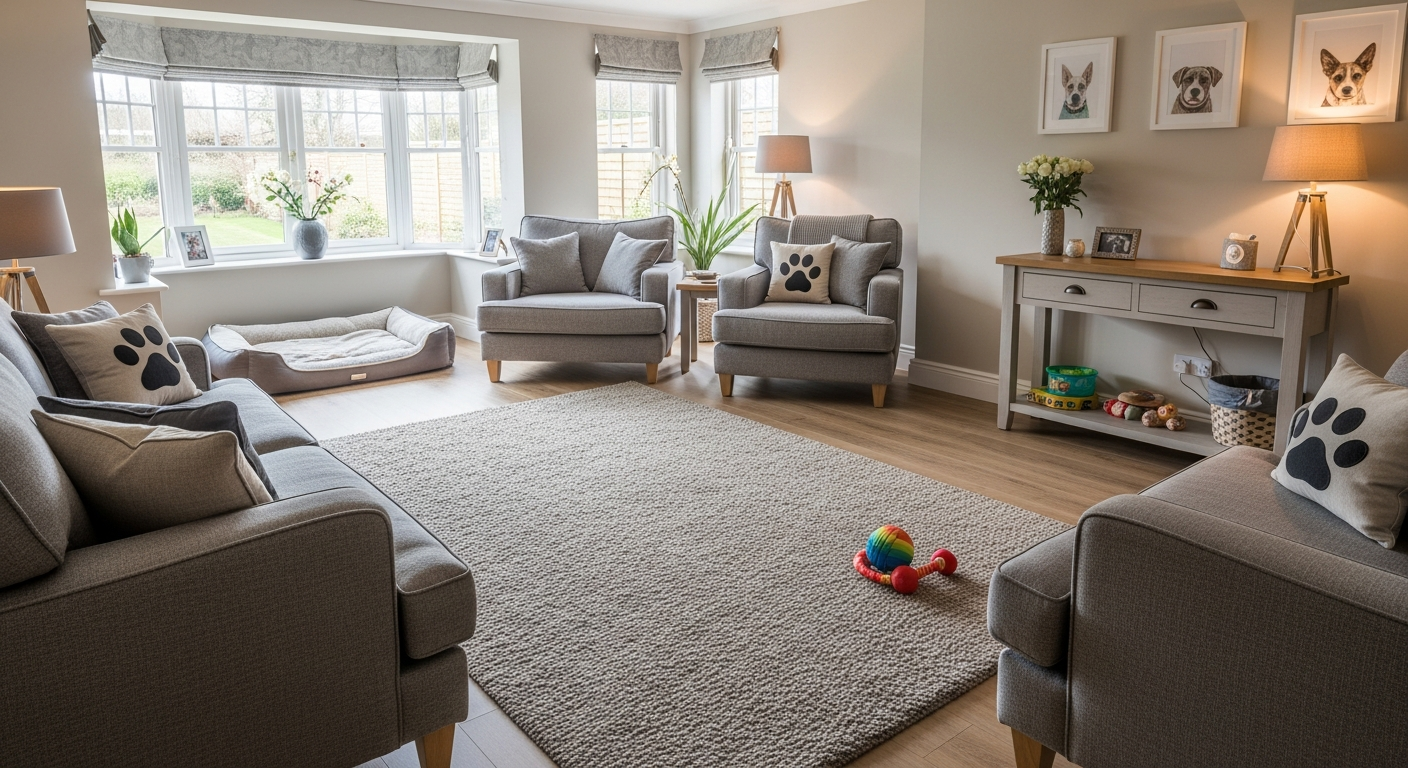
30 seconds summary
To design a living room for large breeds like an adult Doberman, prioritize “spatial intelligence” over traditional decor. Focus on creating 36 inches wide walkways and clearing “desire paths” between doorways to prevent collisions.
Key strategies include:
- Safe Turn Zones: Swap sharp-edged coffee tables for soft ottomans to accommodate a dog’s wide turning radius.
- Traction: Use secured rug runners on slick floors to prevent joint injuries.
- Vertical Safety: Move breakables above the “30-inch wag zone” and use wall-mounted lighting to keep the floor clear.
Creating a home that feels both stylish and functional is a challenge for any homeowner, but when your primary roommate is a 90-pound powerhouse of muscle and enthusiasm, the stakes change. Large breeds, from the sprawling Great Dane to the sleek, high-energy adult Doberman, require more than just a big bed in the corner. They require “spatial intelligence” in your interior design.
Living with big dogs often feels like living with a sentient piece of furniture that insists on moving at high speeds. Without a strategic layout, your living room becomes a gauntlet of bruised shins, knocked-over coffee tables, and trapped pets.
Here is how to master the architecture of a large-dog-friendly living space, focusing on clear traffic patterns and safe maneuverability.
The Anatomy of a Large Dog’s Movement
To design a room for a big dog, you first have to understand how they move. Unlike humans, who can pivot on a dime, large dogs have a wide turning radius.
- The “Semi-Truck” Factor: Large dogs don’t just turn; they arc. If a walkway is too narrow, a big dog will often bump their hips against furniture, leading to “furniture creep,” where your sofa slowly migrates across the room.
- The Braking Distance: High-energy breeds don’t always stop immediately. If a hallway opens directly into a cluttered seating area, the dog may slide on rugs or collide with low tables.
- The Tail Sweep: A happy tail is a lethal weapon. Any “clear walkway” must account for the 24-inch “wag zone” on either side of the dog’s body.
Mapping the “Main Artery” Walkways
The most common mistake in living room layouts is placing furniture in the natural “desire paths”, the straightest lines between doors.
Prioritize the Perimeter
Instead of centering your seating group in a way that forces the dog to weave through chairs, pull your furniture inward to create a wide perimeter track.
- The 36-Inch Rule: Aim for walkways that are at least 36 inches wide. This allows a large dog to pass a human without either party having to flatten themselves against a wall.
- Entry/Exit Buffers: Keep the areas around doorways completely clear. If a dog hears the doorbell, they will launch toward the door. Any decorative plant or coat rack in that 5-foot radius is a casualty waiting to happen.
Floating Furniture
If you have a massive open-concept room, “float” your sofa in the center. This creates a circular path around the furniture. This “racetrack” layout is ideal because it prevents the dog from feeling cornered and allows them to burn off “zoomie” energy without jumping over the furniture.
Creating Safe Turn Zones
A “Turn Zone” is a designated open area where a dog can change direction, shake their coat, or stretch out without hitting an obstacle.
The “Hub” Concept
Designate the center of the room or a specific corner as the “Hub.” This area should be free of coffee tables. While a beautiful reclaimed wood table looks great, it often occupies the exact space a dog needs to pivot.
- The Ottoman Alternative: Replace hard-edged coffee tables with large, sturdy upholstered ottomans. They are softer on canine hips and lack the sharp corners that can injure a dog (or a human) during a collision.
- Corner Clearance: Ensure that the corners of the room aren’t “dead zones” filled with floor lamps. A large dog trying to turn in a tight corner will almost certainly tip a top-heavy lamp.
Flooring: The Foundation of Safety
A clear walkway is useless if it’s slippery. For a large breed like an adult Doberman, traction is a safety requirement, not a luxury. Constant slipping on hardwood can lead to long-term joint issues or acute ACL tears.
Securing the Path
If you have hard floors, use rug runners to define the walkways. However, these must be secured with high-quality, non-slip rug pads. A sliding rug is more dangerous than a slick floor because it provides a false sense of security.
Furniture Selection for the Big Dog Household
Your furniture acts as the “walls” of your dog’s walkways. Choosing the right pieces can drastically reduce the feeling of clutter.
- Legged vs. To-the-Floor: Furniture with legs (Mid-century modern style) creates visual “air,” making the room feel bigger. However, balls and toys will constantly get stuck under there. Furniture that sits flush to the floor eliminates the “stuck toy” whining, but can feel bulkier in a tight space.
- Rounded Edges: If you must have a coffee table, choose a circular or oval design. This allows the dog’s body to “roll” off the edge rather than catching a sharp corner.
- Weight Matters: Lightweight chairs will be pushed around by a large dog’s sheer weight. Choose heavy, grounded pieces that won’t move when a dog leans against them.
Integrating the “Big Dog Bed”
A major layout hurdle is the “mattress-sized” dog bed. Often, these are placed in the middle of a walkway, becoming a tripping hazard.
The Inset Bed
Look for ways to “tuck” the bed away while keeping it in the social heart of the room:
- Under Console Tables: A long, high console table can house a large dog bed underneath. It provides a “den” feel for the dog while keeping the bed out of the foot traffic.
- The Sofa Extension: Place the dog bed at the end of the sofa, effectively extending the footprint of the couch rather than creating a new “island” of fabric in the middle of the floor.
Verticality and “The Tail Zone”
When you have a large dog, you must stop thinking about the floor and start thinking about the 30-inch horizontal plane. This is the height of most coffee tables and exactly where the average large dog’s tail resides.
- Clear the “Wag Horizon”: Keep breakables off surfaces that are lower than 32 inches. Use floating shelves for your favorite decor.
- Wall-Mounted Lighting: Swap floor lamps for wall sconces. This removes the “tripod” legs that big dogs tend to tangle with and opens up floor space for wider walkways.
Case Study: The High-Energy Layout
Imagine a room designed for an adult Doberman. This is a breed that is tall, lean, and incredibly fast. A “static” layout with a center coffee table and narrow paths will result in a frustrated dog and broken shins.
The Solution:
- L-Shaped Sectional: Pushed against two walls to open up the maximum amount of floor space.
- No Coffee Table: Replaced by two small side tables nestled next to the sofa arms.
- The Runway: A 4-foot wide clear path from the kitchen to the backyard door, lined with a heavy-duty rubber-backed runner.
- The Soft Corner: A dedicated corner with a recessed orthopedic bed, away from the “swing” of the door.
Final Checklist for a Spacious Layout
Before you finalize your room, walk through it and ask yourself these three questions:
- Can I walk through the room in the dark without hitting anything? If you can’t, your dog definitely can’t.
- Is there a 360-degree pivot point? Find the spot where your dog hangs out most. Ensure they can turn around fully without their tail hitting a vase or a lamp.
- Are the “Visual Cues” clear? Use different rug textures to signal to the dog where the “zoomie zone” ends and the “quiet zone” (near the breakables) begins.
Conclusion
Living with a large dog doesn’t mean sacrificing your aesthetic or living in a padded cell. It simply requires a shift in perspective, moving away from “clutter-core” and toward a streamlined, intentional floor plan. By prioritizing wide walkways, eliminating “trip” hazards, and choosing furniture that respects the physics of a large animal, you create a sanctuary that is as comfortable for your adult Doberman as it is for you.