
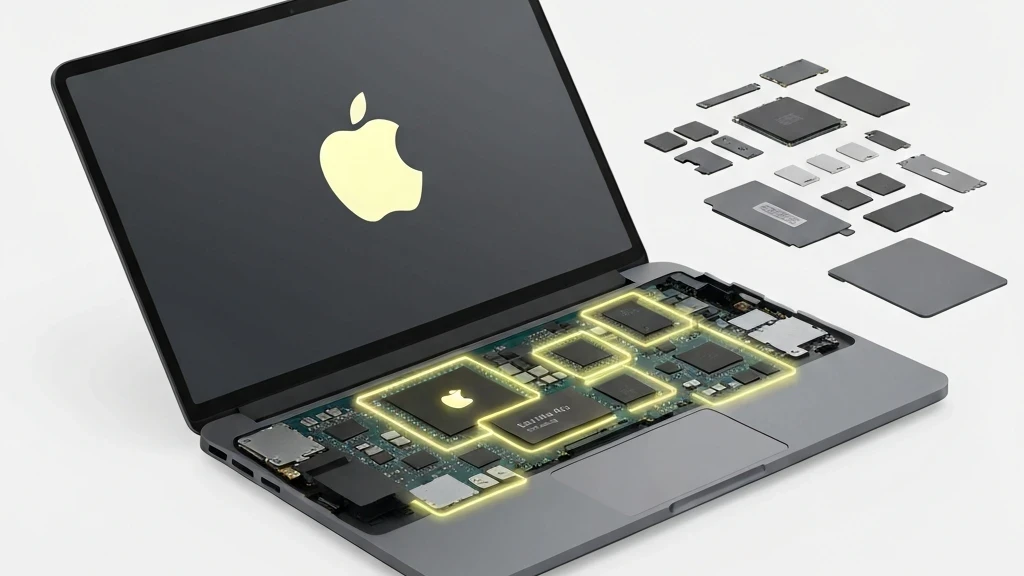
The term “genuine Apple hardware parts” often evokes a sense of exclusivity and proprietary design. While Apple is renowned for its vertical integration and custom silicon, the reality of its supply chain is a sophisticated blend of in-house innovation and strategic partnerships with a global network of specialized vendors. This article will dissect what constitutes genuine Apple parts within Mac products, explore Apple’s reliance on third-party suppliers, and draw a comparison between Apple’s hardware strategy today versus 7-8 years ago.
The Anatomy of Apple Mac Products and Internal Hardware
Apple’s Mac lineup, comprising MacBooks (Air, Pro), iMacs, Mac mini, Mac Studio, and Mac Pro, represents a carefully engineered ecosystem where hardware and software are designed to work in harmonious concert. At their core, Macs are complex machines built from a multitude of sophisticated components.
The typical internal hardware architecture of a Mac includes:
- Logic Board (Motherboard): The central nervous system, connecting all major components.
- Processor (CPU/SoC): The “brain” that executes instructions. This has seen a significant shift for Apple, moving from Intel CPUs to their custom-designed Apple Silicon (System on a Chip).
- Graphics Processor (GPU): Handles visual rendering tasks, often integrated within the SoC or, historically, as a discrete chip from vendors like AMD.
- Memory (RAM): Temporary storage for active applications and data, crucial for multitasking.
- Storage (SSD): Persistent storage for the operating system, applications, and user data. Apple exclusively uses Solid State Drives (SSDs) for speed and durability.
- Display Panel: The visual interface, often featuring Apple’s Retina or Liquid Retina XDR technology.
- Battery: For portable Macs, providing untethered power.
- Connectivity Modules: Wi-Fi, Bluetooth, and potentially cellular components.
- Sensors: Accelerometers, ambient light sensors, temperature sensors, Hall effect sensors, and potentially biometric sensors (Touch ID).
- Peripherals & Ports: USB-C/Thunderbolt controllers, audio components, webcam (FaceTime camera), speakers, microphones.
- Enclosure: The meticulously crafted aluminum chassis or glass and metal designs.
- Custom Apple Silicon: Beyond the main CPU, Apple incorporates dedicated silicon for various functions, such as security (Secure Enclave), display control, power management, and specialized accelerators (Neural Engine).
Apple’s design philosophy prioritizes integration, efficiency, and aesthetics, often leading to highly customized and tightly integrated components.
What are “Genuine Apple Hardware Parts”?
Defining “genuine Apple hardware parts” is crucial. It refers to components that are designed, specified, and often branded by Apple, whether they are manufactured directly by Apple or by a third-party vendor under strict Apple guidelines.
-
Apple-Designed and Manufactured/Assembled Parts: These are the components where Apple exerts the most control, from concept to production. The prime examples are the Apple Silicon M-series chips (CPU, GPU, Neural Engine, memory controller, Secure Enclave, etc., all on a single die or package). Other examples include custom controllers, specific firmware, the entire logic board design, and the external enclosure, which is precisely engineered by Apple. These parts often carry explicit Apple branding or part numbers.
-
Apple-Specified and Sourced Parts from Third-Party Vendors: This category represents the vast majority of individual components within an Apple product. Apple does not manufacture raw NAND flash memory, RAM chips, display panels, or battery cells itself. Instead, it sources these from leading global manufacturers, but with a critical distinction: these are not off-the-shelf components.
- Apple provides exacting specifications for performance, power consumption, reliability, physical dimensions, and security.
- Vendors often produce custom versions of their standard components exclusively for Apple.
- These components undergo rigorous testing and validation by Apple.
- Once integrated into an Apple product, these parts become integral to the “genuine Apple experience” and are considered genuine parts of an Apple product.
The essence of “genuine” lies in their adherence to Apple’s exacting standards and their role in enabling the intended functionality, performance, security, and reliability of the device as designed by Apple. Using non-genuine parts can lead to performance issues, compatibility problems, security vulnerabilities, and may even void warranties or disable certain features (e.g., True Tone display, battery health reporting).
Apple’s Reliance on Other Vendors
Despite its reputation for self-sufficiency, Apple remains deeply reliant on a global network of highly specialized suppliers for nearly every sub-component that makes up a Mac. This is a common practice in the electronics industry, where specialization leads to higher quality and efficiency.
Key component categories and examples of where Apple sources from vendors (without naming specific current partners due to proprietary information, but broadly representative):
- Memory (RAM): Suppliers like Samsung, SK Hynix, and Micron are major providers of DRAM modules and chips.
- NAND Flash Storage: Samsung, Kioxia (formerly Toshiba Memory), Western Digital (SanDisk), SK Hynix, and Micron are key players in NAND flash memory, used in Apple’s SSDs.
- Display Panels: LG Display, Samsung Display, and BOE are leading manufacturers of the LCD and OLED panels that go into Mac displays.
- Battery Cells: Companies such as LG Energy Solution, Amperex Technology Limited (ATL), and BYD produce the lithium-ion battery cells. Apple then designs the battery pack and power management system.
- Connectivity Chips: Broadcom is a well-known supplier for Wi-Fi and Bluetooth chips.
- Sensors: STMicroelectronics, Bosch Sensortec, and other specialized sensor companies provide accelerometers, gyroscopes, magnetometers, and other environmental sensors.
- Passive Components: Resistors, capacitors, inductors, and various micro-electromechanical systems (MEMS) are sourced from a vast array of global suppliers.
- Camera Modules: While Apple designs the camera’s image processing, the physical camera modules themselves are often supplied by partners.
- Enclosure Materials: Specific aluminum alloys and glass components are manufactured by specialized foundries and glassmakers according to Apple’s design and material specifications.
It is critical to understand that even though these components originate from third-party vendors, they are integrated and often customized to such an extent that they become indispensable parts of Apple’s proprietary ecosystem. The “genuine” aspect is less about who physically manufactures the basic chip and more about it being the exact component Apple selected, tested, and approved for that specific device, often with custom firmware or integration.
Apple Now vs. 7-8 Years Ago (Circa 2016-2017)
The past 7-8 years have seen a monumental shift in Apple’s hardware strategy, particularly for its Mac lineup. The evolution is marked by increasing vertical integration, custom silicon, and a deeper control over the user experience.
| Feature Area | Apple 7-8 Years Ago (e.g., 2016-2017 Macs) | Apple Now (e.g., 2023-2024 Macs) | Impact |
|---|---|---|---|
| Main Processor | Primarily Intel x86-64 CPUs. Varied performance tiers, reliant on Intel’s roadmap. | Predominantly Apple Silicon (M-series SoCs). ARM-based, custom-designed by Apple. | Performance & Efficiency: Significantly better performance-per-watt, unified memory architecture. Control: Apple dictates its own roadmap, not reliant on Intel’s release schedule. Better hardware-software co-optimization. |
| Graphics (GPU) | Integrated Intel GPUs or discrete AMD/Nvidia GPUs for Pro models. | Integrated GPU within Apple Silicon SoC. Highly optimized for Apple’s ecosystem. | Integration: Tighter integration with CPU and memory, eliminating bottlenecks. Power: More power-efficient graphics, particularly for integrated solutions. |
| Custom Silicon | Introduction of T-series chips (e.g., T1 for Touch Bar, T2 for security, SSD controller). | M-series SoCs integrate nearly everything (CPU, GPU, Neural Engine, Secure Enclave, Media Engine, I/O) onto a single chip. | Security: Enhanced hardware-level security (Secure Enclave). Performance: Specialized accelerators for tasks like AI/ML (Neural Engine) and video encoding/decoding. Efficiency: Holistic power management. |
| Memory (RAM) | Often discrete RAM modules (sometimes user-upgradeable on non-Pro models like iMacs, Mac Pro). | Unified Memory Architecture (UMA) on-package with the M-series SoC, or soldered directly to the logic board. | Bandwidth & Latency: Extremely high bandwidth and low latency due to UMA. User Upgradeability: Virtually non-existent; RAM must be configured at purchase. |
| Storage (SSD) | Proprietary SSD modules or soldered storage. T2 chip began encrypting SSDs. | Custom SSD controllers integrated into M-series SoCs, or tightly coupled via T2/M-series chips; often soldered. | Security: Strong hardware-level encryption. Performance: Very high-speed internal storage. Repairability/Upgradeability: Extremely difficult or impossible for users to upgrade/replace due to integration and encryption. |
| Repairability/ Modularity | Challenging but some components (RAM on certain models, SSDs on some older laptops) were theoretically replaceable. | Significantly reduced. Components like RAM, SSDs, and often even power buttons or display components are serialized and tied to the logic board. | Increased Repair Costs: Repairs typically require Apple or AASPs. Replacement parts often necessitate software recalibration or “pairing” to the logic board, disabling independent repair. |
| Supply Chain Control | Strong, but still integrating a core x86 processor architecture from Intel. | Much deeper vertical integration with Apple Silicon. Apple dictates more fundamental specifications. | Resilience & Innovation: Greater control over product performance, features, and supply chain logistics. Ability to differentiate more significantly from competitors. |
Conclusion
Genuine Apple hardware parts are not simply components bearing an Apple logo; they are a testament to Apple’s design philosophy and rigorous quality control. They represent either Apple’s own groundbreaking silicon designs or meticulously specified components from leading third-party vendors that meet Apple’s exacting standards.
The transformation over the past 7-8 years, particularly with the transition to Apple Silicon, signifies Apple’s relentless pursuit of vertical integration. This shift has given Apple unprecedented control over the performance, power efficiency, and security of its Mac products, leading to a highly optimized user experience. However, it has also resulted in increasingly integrated and less modular hardware, making user upgrades and third-party repairs significantly more challenging. Understanding what constitutes “genuine” is key to appreciating the engineering marvels that Macs are, and the intricate web of design and supply that brings them to life.