
30 seconds summary
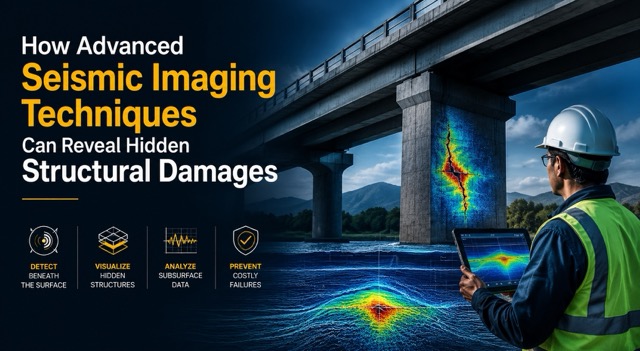
- Advanced seismic imaging helps detect hidden structural damage by sending waves through materials and analyzing how they travel. Cracks, voids, weak zones, corrosion, and foundation problems change wave speed, direction, and strength.
- Techniques like seismic tomography, surface wave analysis, reflection methods, and ultrasonic imaging allow engineers to see inside bridges, tunnels, dams, buildings, and foundations without damaging them.
- These methods improve safety, support early repairs, reduce maintenance costs, and help prevent sudden structural failure.
Structures such as bridges, tunnels, dams, high-rise buildings, pipelines, and industrial facilities are expected to remain safe and functional for many years. However, many forms of structural damage begin deep inside materials where they cannot be seen from the surface. Cracks, voids, corrosion zones, delamination, weak foundations, and internal fractures may develop slowly and remain hidden until they become serious threats. Traditional inspection methods, such as visual surveys, hammer tapping, or limited drilling, often detect only surface-level problems. This is where advanced seismic imaging techniques become highly valuable.
Advanced seismic imaging uses controlled vibrations, waves, sensors, and computer-based analysis to “look inside” structures and the ground beneath them. These techniques work by studying how seismic waves travel through materials. When waves encounter cracks, voids, loose zones, or changes in material stiffness, their speed, direction, amplitude, and frequency content change. By measuring these changes, engineers can identify hidden damage without destroying the structure.
Understanding Seismic Imaging
Seismic imaging is based on the behavior of mechanical waves. When a vibration is introduced into a structure or the ground, energy travels through the material in the form of waves. These waves may be produced by small impact hammers, vibration devices, piezoelectric actuators, or natural sources such as traffic and machinery. Sensors placed on the surface record the returning signals.
Healthy materials allow waves to travel in predictable ways. Damaged areas disturb wave movement. For example, a crack may reflect part of the wave, a void may slow it down, and a weak zone may absorb energy. By comparing recorded wave patterns with expected behavior, engineers can locate and estimate the severity of internal defects.
Why Hidden Structural Damage Is Dangerous
Hidden structural damage is dangerous because it can grow unnoticed. A small internal crack in concrete may expand due to repeated loading, moisture, or temperature changes. Corrosion inside reinforced concrete may weaken steel bars long before rust stains appear outside. Voids under foundations can cause settlement and instability. In bridges and tunnels, hidden defects may reduce load-bearing capacity and increase the risk of sudden failure.
The main problem is that visible inspections do not always reveal the true condition of a structure. A wall, slab, or bridge deck may appear sound while internal damage is progressing. Advanced Seismic technologies help solve this problem by providing a deeper and more detailed understanding of structural health.
Seismic Tomography
Seismic tomography is one of the most powerful imaging techniques. It works in a way similar to medical CT scanning. Waves are sent through a structure from different angles, and sensors record how long they take to arrive. Areas where waves travel slowly may indicate cracks, weak concrete, voids, or moisture-related damage.
Engineers use computer algorithms to convert wave travel-time data into images. These images show zones of different wave velocities. High-velocity areas usually suggest dense and strong material, while low-velocity areas may suggest damage or weakness. Seismic tomography is useful for inspecting dams, bridge piers, tunnels, foundations, and large concrete blocks.
Surface Wave Methods
Surface wave techniques analyze waves that travel along the surface of a structure or ground. These waves are sensitive to changes in stiffness at different depths. By studying their speed at different frequencies, engineers can estimate material properties below the surface.
One common method is Multichannel Analysis of Surface Waves, often called MASW. It is widely used to investigate soil layers, pavement systems, and foundations. If a weak layer, cavity, or softened zone exists beneath a structure, surface wave analysis can help detect it. This is especially useful for identifying foundation problems before they cause visible settlement or cracking.
Reflection and Refraction Techniques
Reflection and refraction methods are also important in seismic imaging. In reflection testing, waves bounce back when they encounter a boundary or defect. The reflected signals are analyzed to determine the depth and location of hidden features. In refraction testing, engineers study how waves bend as they pass through layers with different properties.
These methods are commonly used in geotechnical engineering, tunnel inspection, and subsurface investigation. They can reveal hidden cavities, fractured rock, weak soil layers, and buried structural elements. For buildings and bridges, reflection-based methods can help locate internal cracks or delamination in concrete members.
Full-Waveform Inversion
Full-waveform inversion is an advanced computational method that uses the entire recorded seismic signal rather than only arrival times. It compares measured waveforms with simulated waveforms and repeatedly updates a model until the difference becomes small.
This method can produce highly detailed images of internal conditions. It can identify subtle changes in stiffness, density, and damage distribution. Although it requires strong computing power and high-quality data, full-waveform inversion is becoming increasingly important in structural health monitoring and engineering diagnostics.
Ultrasonic and High-Frequency Seismic Imaging
For smaller structural elements, high-frequency seismic or ultrasonic imaging is often used. Ultrasonic waves have shorter wavelengths, allowing them to detect smaller defects. These techniques are useful for inspecting concrete slabs, steel components, welds, columns, and beams.
When ultrasonic waves pass through damaged material, they may scatter, weaken, or reflect. Engineers can use this information to find cracks, honeycombing, delamination, and internal voids. Ultrasonic pulse velocity testing is one common method used to evaluate concrete quality.
Detecting Cracks and Fractures
Cracks are among the most common forms of structural damage. Some cracks are visible, but many begin internally. Seismic imaging can detect cracks by observing wave reflection, scattering, or velocity reduction. A crack often acts as a barrier that changes how waves move through a material.
The orientation and size of a crack can also affect wave behavior. By using sensors in different positions, engineers can estimate the crack’s location and direction. This helps them decide whether repair is needed and how urgent the problem is.
Identifying Voids and Cavities
Voids are empty spaces within or beneath structures. They may form due to poor construction, soil erosion, water leakage, or material deterioration. Voids are dangerous because they reduce support and may cause collapse or settlement.
Seismic waves behave differently when they encounter air-filled or water-filled cavities. The wave speed may decrease, reflections may become stronger, and signal energy may be lost. Seismic imaging can map these abnormal zones and help engineers locate hidden cavities before they become critical.
Evaluating Foundations and Subsurface Conditions
A structure is only as stable as its foundation. Many structural problems begin below ground, where they are difficult to inspect directly. Seismic imaging can evaluate soil layers, rock quality, buried voids, and foundation contact conditions.
For example, if a building is experiencing uneven settlement, seismic testing can help determine whether the cause is weak soil, underground cavities, or poor foundation support. In bridge foundations, seismic methods can help assess scour effects, pile integrity, and subsurface erosion.
Monitoring Bridges, Dams, and Tunnels
Large infrastructure systems benefit greatly from seismic imaging. Bridges are exposed to traffic loads, weather, vibration, and corrosion. Dams face water pressure, seepage, and foundation stress. Tunnels experience ground movement, water infiltration, and lining deterioration.
Seismic imaging allows engineers to inspect these structures without major disruption. Hidden cracks in tunnel linings, weak zones inside dams, and deteriorated bridge decks can be detected more effectively. Regular seismic monitoring can also show whether damage is growing over time.
Role of Sensors and Data Processing
Modern seismic imaging depends heavily on sensor technology and data processing. Sensitive accelerometers, geophones, fiber-optic sensors, and wireless sensor networks can record very small vibrations. These sensors collect large amounts of data from different parts of a structure.
Computer algorithms then process the signals to remove noise, enhance useful information, and create images or models. Machine learning is increasingly being used to recognize damage patterns automatically. This combination of sensors and intelligent analysis makes seismic imaging faster, more accurate, and more practical.
Advantages of Advanced Seismic Imaging
One major advantage of seismic imaging is that it is non-destructive. Engineers can investigate hidden damage without cutting, drilling, or damaging the structure. This reduces cost, saves time, and allows inspections to be performed while the structure remains in service.
Another advantage is depth. Visual inspections only show the surface, but seismic waves can travel through materials and reveal internal conditions. Seismic imaging can also cover large areas, making it useful for bridges, dams, tunnels, roads, and foundations.
It also supports preventive maintenance. Instead of waiting for visible damage or failure, engineers can detect early-stage problems and repair them before they become severe.
Limitations and Challenges
Despite its benefits, seismic imaging has limitations. Results can be affected by noise, complex geometry, material variation, and poor sensor placement. Interpreting seismic data requires experience and careful analysis. In some cases, different types of damage may produce similar wave responses, making confirmation with other methods necessary.
Advanced techniques such as full-waveform inversion may require expensive equipment and powerful computing resources. However, as technology improves, these methods are becoming more accessible and reliable.
Future of Seismic Imaging
The future of seismic imaging is closely linked with digital technology. Artificial intelligence, real-time monitoring, drone-based sensors, robotic inspection systems, and digital twins are making structural assessment more advanced. In the future, structures may be continuously monitored by embedded sensors that detect damage as soon as it begins.
Seismic data can also be integrated with other inspection methods such as ground-penetrating radar, infrared thermography, and acoustic emission testing. Combining multiple methods gives engineers a more complete picture of structural health.
Conclusion
Advanced seismic imaging techniques play a vital role in revealing hidden structural damage. By studying how waves move through materials, engineers can detect cracks, voids, weak zones, foundation problems, and internal deterioration that may not be visible from the surface. These methods improve safety, reduce maintenance costs, and support better decision-making.
As infrastructure continues to age, the need for reliable non-destructive testing will grow. Seismic imaging provides a powerful way to protect buildings, bridges, tunnels, dams, and other important structures. With continued development in sensors, computing, and data analysis, seismic imaging will become even more accurate and essential for modern structural health monitoring.